Understanding Pediatric Dental X-rays: Safety and Benefits
Dental care for children often requires unique approaches tailored to their developing dentition and growing independence, and one type of care that they can receive is pediatric dental X-rays. However, parents often wonder whether exposing young children to X-rays is more harmful than helpful, so it is common to have questions about this type of procedure.
Pediatric dental X-rays are among the most useful tools at a dentist’s disposal to keep a child safe from oral health issues and ensure that they have a functional smile ready for adulthood. Here is what parents should know about X-rays for kids, from the safety considerations to the potential benefits.
Pediatric dental X-rays: What to know
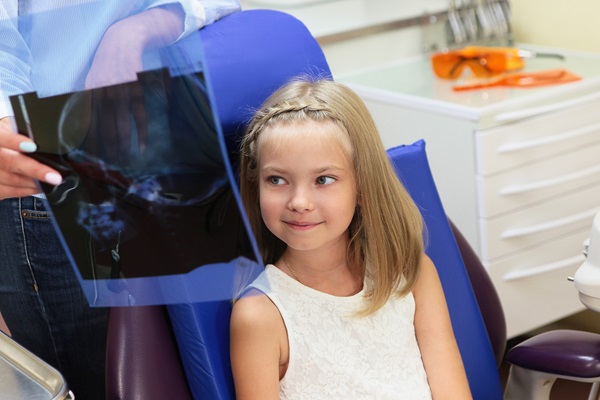
A pediatric dental X-ray provides a more comprehensive view of a child’s mouth than the dentist can perceive visually, helping to spot issues below the surface. However, some parents believe that X-rays may not be necessary before their children become adults, especially since they will lose their baby teeth, anyway.
Are pediatric dental X-rays safe?
Many parents are concerned about the dose of radiation that their child is exposed to during an X-ray session. Fortunately, due to advancements in medical technology, digital X-rays are now widely available and can take quality images while using about 90% less radiation than older X-ray machines. This means children are exposed to radiation similar to what they would experience just from being out in the sun for a little while. To further mitigate exposure, dentists will place a special covering over the child.
Why get dental X-rays?
Dental x-rays are essential for children, even if they will lose their baby teeth later. In fact, this stage of life is vital for long-term good oral health, and spotting problems now can help the smile later.
For instance, dentists may find underlying issues with alignment, bite, or decay that are not immediately visible upon regular examination. X-rays reveal the tooth roots, and some are even sensitive enough to provide limited nerve and blood supply images. All these factors result in better care for the child, as the dentist can see problems before they begin to cause pain, discomfort, or issues that require more invasive intervention.
How does the X-ray process work?
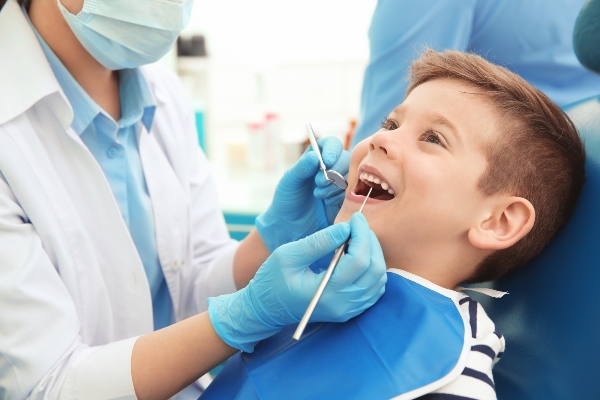
Getting a pediatric dental X-ray is simple. First, the child will sit in a comfortable chair, and the dentist will place a heavy apron or bib over the child. This covering is heavy because it is made of lead, which prevents X-rays from penetrating it. This keeps the child safe from any radiation that is not essential for capturing the necessary pictures.
Then, the dentist will get the machine ready. Usually, it looks like a long robotic arm, and it can be moved around the room to get the right angle. The next part depends on the type of X-ray machine that the dentist is using. Usually, the dentist will give the child a small plastic frame to bite down on. This frame contains X-ray film, which helps the machine clearly capture the correct parts of the mouth as a picture. Biting down on the frame keeps the X-ray film in place so it does not move when the machine is working.
Finally, the dentist will step away to turn the machine on and take a picture. Taking an X-ray is just as fast as taking a photo with a camera, so the child will not need to sit still for long. However, having the parent help keep the child still is helpful because moving can make the X-ray less clear.
Depending on how many X-rays are needed and in which parts of the mouth, the dentist might move the plastic piece slightly and ask the child to bite onto it again. Once the dentist has finished taking the X-rays, the child will return the plastic frame, and the process is complete!
Get pediatric dental x-rays on schedule
Every child should get dental X-rays at least once per year, especially when their baby teeth are erupting and their adult teeth are developing and emerging. This ensures that the dentist can spot problems while they are still minor. Parents do not need to worry about the minimal radiation exposure, as it is similar to what children experience in their everyday lives.
If your child is due for pediatric dental X-rays or if you have more questions, do not hesitate to reach out. Contact us at any time to schedule an appointment with our pediatric dentist for X-rays or to ask questions.
Request an appointment here: https://www.grandparkwaypediatricdental.com or call Grand Parkway Pediatric Dental at (832) 579-0960 for an appointment in our Richmond office.
Check out what others are saying about our services on Yelp: Pediatric Dental X-rays in Richmond, TX.
Recent Posts
Whether your child has a cracked, chipped, or decayed tooth, a kids dental crown can restore it to its original shape. An added benefit of dental crowns is that they can last up to 15 years with proper care. Fortunately, caring for crowns is straightforward, with most patients not needing to change their oral hygiene…
Pediatric dentists recommend kids dental crowns for children’s teeth. Veneers are a cosmetic treatment for adults, while dental crowns serve restorative purposes for both adults and children. Here is a closer look at the differences between these two treatments and why dental crowns are the appropriate choice for kids.Dental crowns and veneers are similar in…
Kids dental crowns are a versatile solution in pediatric dentistry. They help protect damaged teeth and support the replacement of missing ones, making them a reliable option for long-term oral health. They can also improve the appearance of the smile. Pediatric dentists recommend crowns to restore function, protect developing teeth, and ensure a healthy, lasting…
A children's root canal helps save baby teeth when deep decay threatens a child’s dental health. When your child has severe tooth pain or a dental injury, deciding whether to treat or remove the tooth can be stressful for parents. Even though baby teeth will eventually fall out, they are important for a child’s oral…